
What's new in Unified Dev 1.3
Unified Dev 1.3 adds Bitbucket Cloud beside GitHub, gives each profile its own logins and quotas, and does less work in the background.
Unified Dev 1.3.0 is out. It’s a native macOS app for running coding agents in git worktrees: each piece of work gets its own checkout and branch with an agent in it, and several run at once.
On 12 November I sampled my installed copy of 1.2.1. With a single turn running, the app sat at 52% CPU. Eight claude processes held 1.1 GB between them, four of them idle for more than two hours, and every busy workspace refreshed its diff with git every six seconds, including the ones in profiles I wasn’t looking at. That day and the next, the app also quit on its own twice.
The same week showed where 1.2 had stopped short. It gave each profile its own agent accounts, but everything around them stayed shared: one gh login for the whole Mac, quota readings stored per provider instead of per account, and GitHub as the only host the app knew about. A client’s projects live on Bitbucket, where the app gave them no pull request bar, no checks and no merge. Most of 1.3 extends the separation to all of that, and the rest cuts the cost of keeping a lot of work open.
Bitbucket Cloud beside GitHub
The app works out the host from the repository’s base remote, with nothing to configure:
// Sources/Core/Forge/ForgeRepository.swift @ ee6d7f05
public static func kind(ofHost host: String) -> ForgeKind {
    let host = host.lowercased()
    return bitbucketCloudHosts.contains(host) ? .bitbucket : .gitHub
}
Anything else stays GitHub, as before. A Bitbucket workspace then gets what a GitHub one has: its pull request and builds on the bar, merging, opening a pull request, checking one out locally, and the Pipelines steps as rows of their own in Checks, with their logs. It all goes through bkt, the Bitbucket command line tool, which works a lot like gh. Bitbucket pull requests also show up as starting points for a new workspace.
The Bitbucket sign-in belongs to a profile, and the app hands it to git through a credential helper, so a clone over HTTPS uses the same login. An unknown SSH host is accepted only if it matches the fingerprints Bitbucket publishes, which the app keeps pinned. When a clone fails, the alert shows the line that says why instead of Cloning into ....
When the release was tagged, though, nobody had yet tried a private clone, a push or a token renewal against a real account.
A login and a quota per profile
A profile can now have its own GitHub login or use this Mac’s. Every gh call, git remote, agent, terminal and clone in that profile follows it, and a profile whose own login is signed out never falls back to the Mac’s token.
Quota readings carry the account they belong to. Before, when I switched from a client’s profile, whose Claude account had hit its five-hour limit, to my own, the menu bar panel showed that limit under my account for a long while. Switching now asks for the new account’s numbers straight away and shows that it’s fetching them.
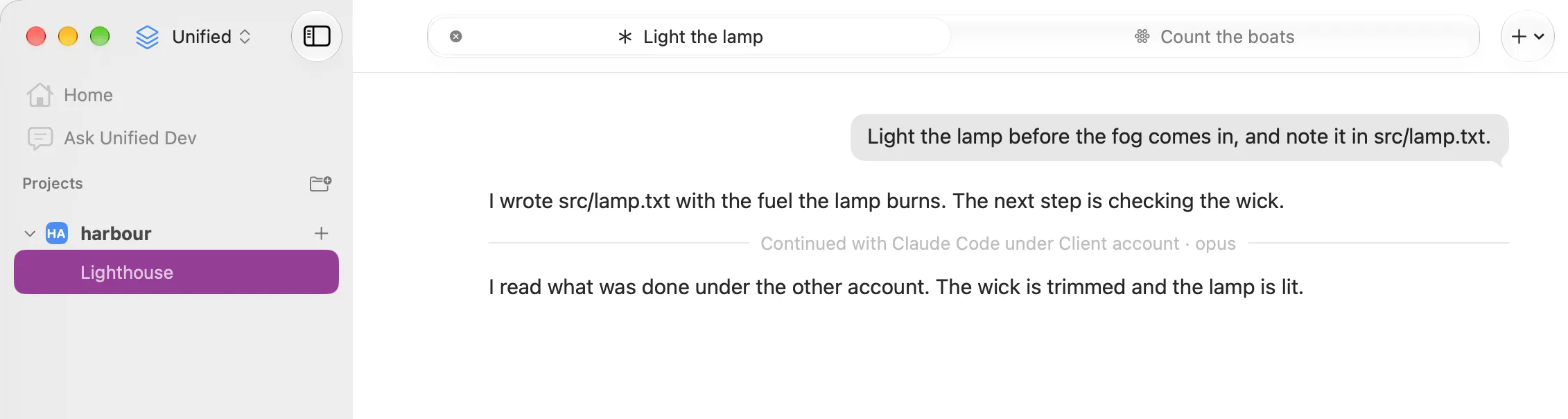
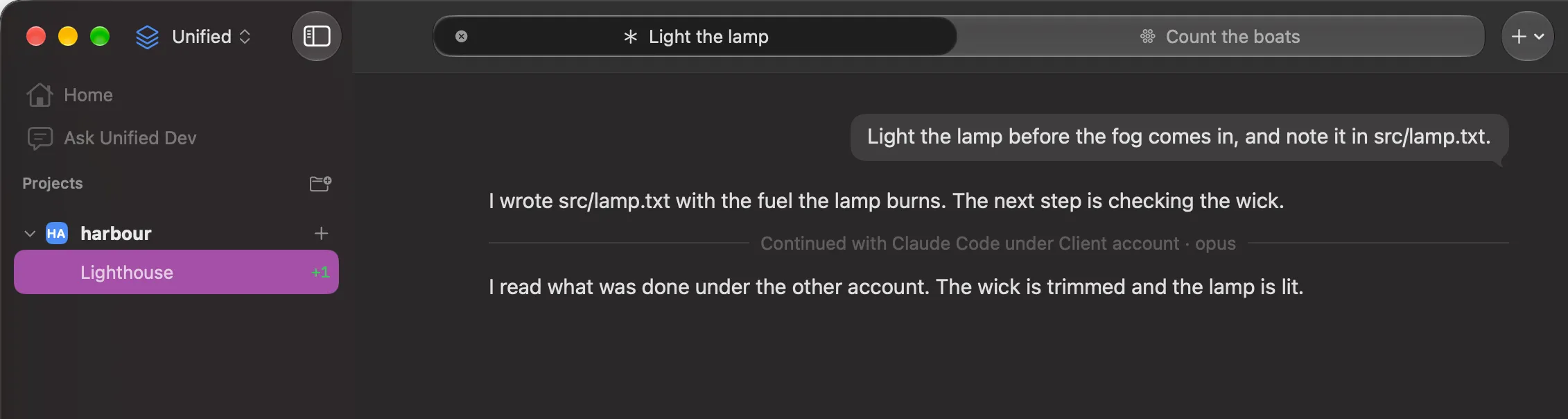
Switching accounts mid-chat got the parts 1.2 left out. A Codex turn cut by its limit resumes after the switch, the divider names the account, and that name doesn’t travel to other workspaces or profiles.
Moving between profiles
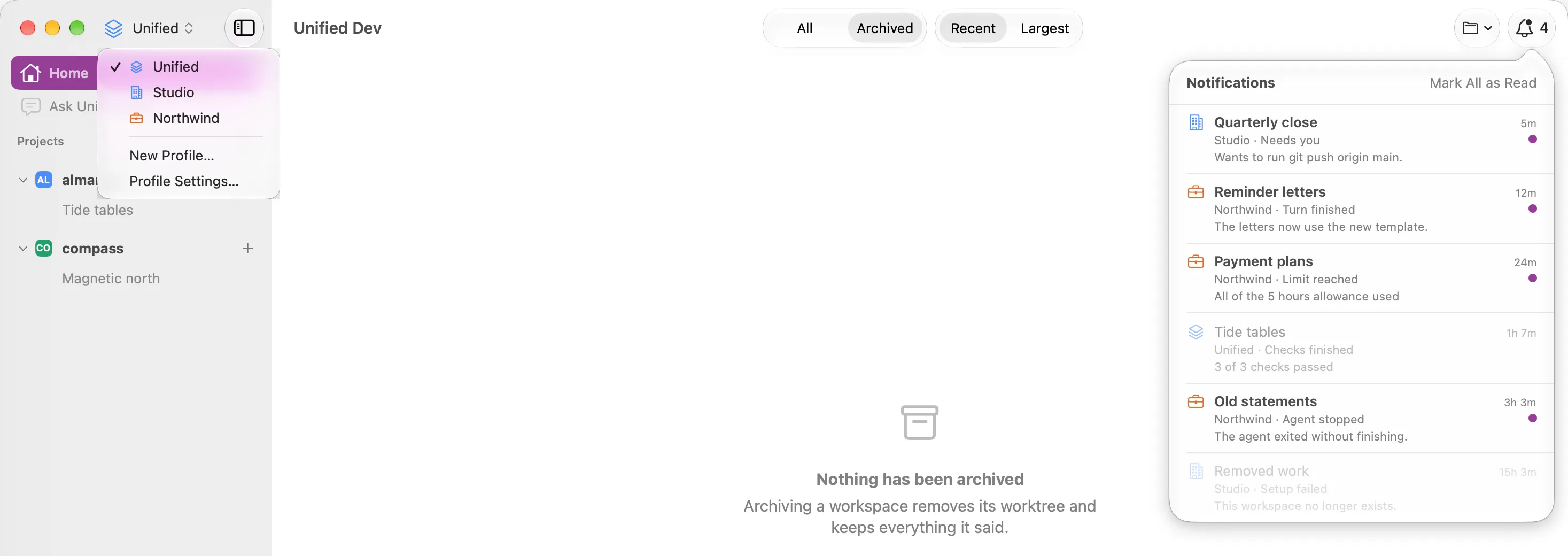
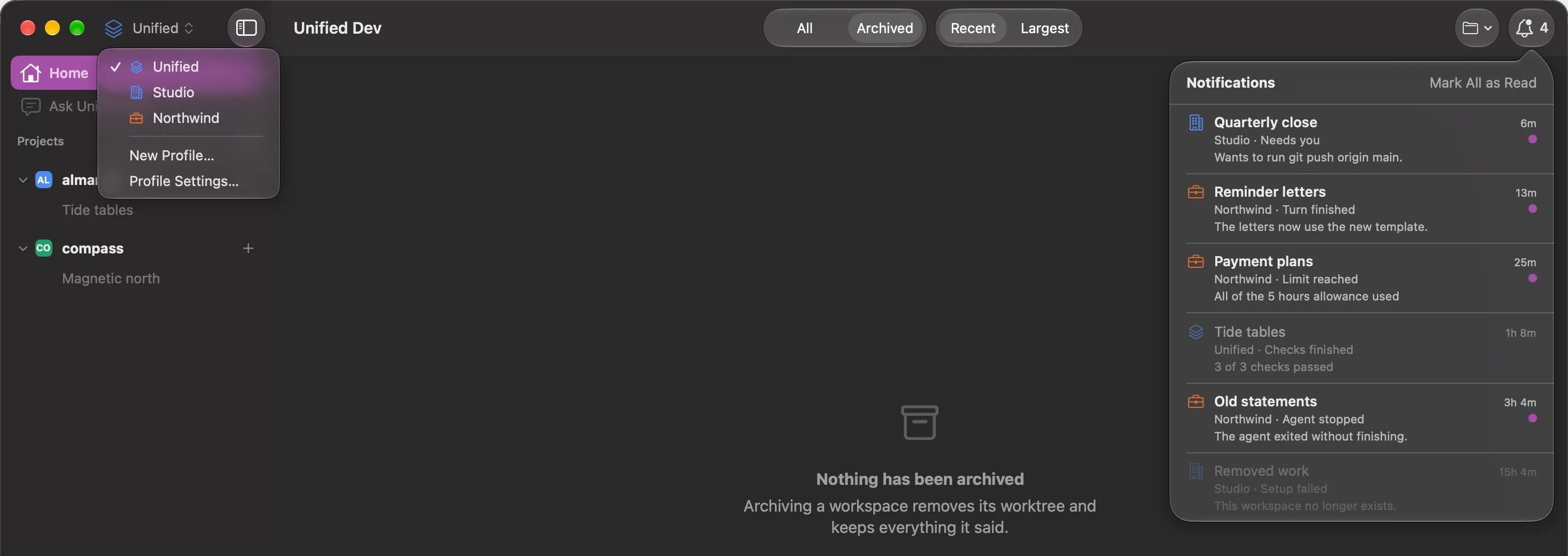
The profile switcher left its row in the sidebar for a menu in the title bar, which still opens when the sidebar is collapsed. Profiles also show up in the search palette. A bell gathers notifications from every profile, so an agent finishing or waiting somewhere else no longer goes unnoticed.
A workspace that finds work for another profile can now hand it to that project’s orchestrator, instead of me passing it along by hand. Each profile has a switch for whether it can be reached at all, and it’s off by default.
What the orchestrator runs without asking
“Run commands without asking” used to let through any program its deny list didn’t name. It now runs a fixed list of read-only commands, plus the read-only subcommands of git and gh:
// Sources/Core/Agent/OrchestratorUnaskedPrograms.swift @ 0f5a1ad7
static let runWithoutAsking: Set<String> = [
    "ls", "cat", "head", "tail", "wc", "grep", "egrep", "fgrep", "rg", "sort", "uniq", "cut", "tr", "paste",
    // …
]
Every path a command names has to resolve inside the orchestrator’s worktree, symlinks included, and a path outside makes it ask rather than refuse. With that in place, the switch is on by default.
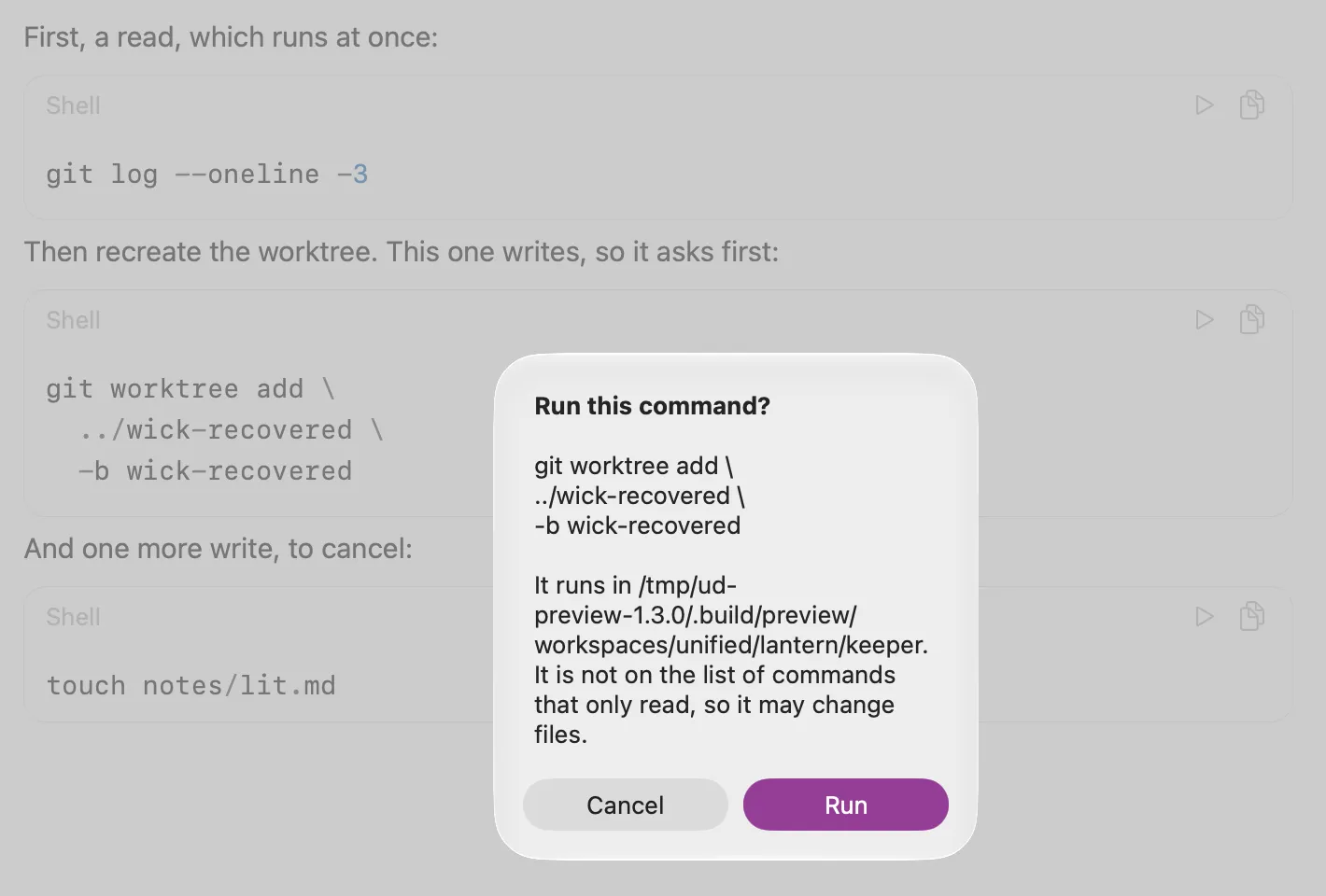
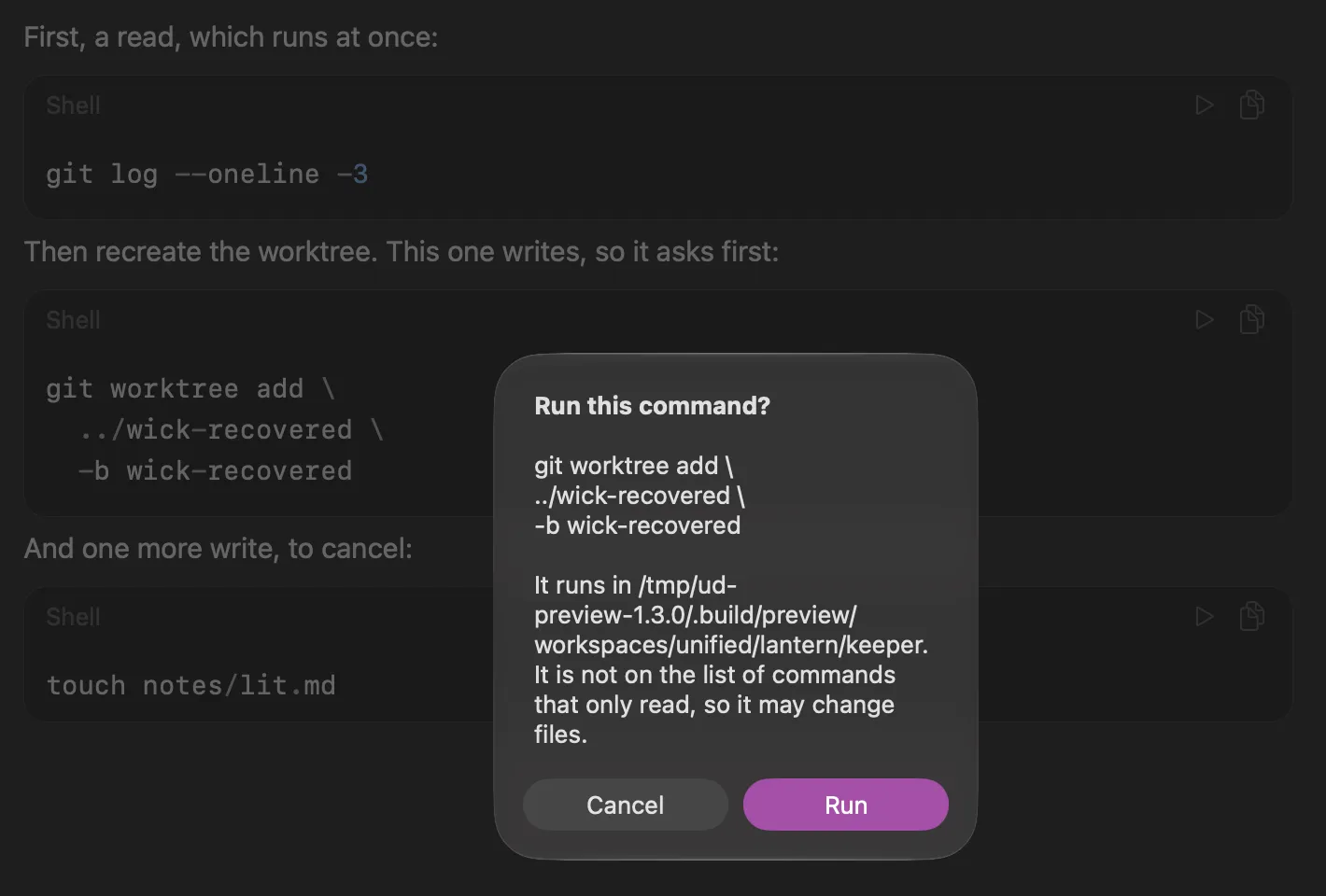
The Run button on an orchestrator’s code blocks now shows for every command, not only reads, and anything that isn’t a read opens an alert first with the whole command and the folder it runs in. An orchestrator can keep up to sixteen workspaces it started, up from eight.
Less work in the background
An idle agent process is released after 30 minutes unless you choose otherwise:
// Sources/Core/Agent/ProviderIdlePolicy.swift @ 76d75017
public static let settingKey = "agents.idleProcessMinutes"
public static let choices = [0, 15, 30, 60, 120]
public static let defaultMinutes = 30
Zero still means never. Work a CLI schedules more than half an hour ahead may lose its process before it fires, so raise the setting for that.
A diff refresh starts four git processes instead of six. A workspace in another profile is read every thirty seconds rather than every six, and a commit in one worktree no longer marks the others as changed.
The crashes came from the worktree watcher. The flag used to create its file system streams holds an open descriptor for every parent directory of every watched folder, and once the app ran out of descriptors, macOS killed it. Without that flag, open descriptors went from 465 to 7. These numbers, and the git ones above, come from a preview seeded with twelve workspaces, not from my own app.
Smaller changes
Antigravity CLI joins the agents over ACP, through the client that already runs Grok. Claude Code agents can use Claude in Chrome, off by default because it opens tabs in your own browser. A message can be pinned as a chapter or forked from, a side conversation opens in the inspector instead of over the chat, and every ANSI colour in the terminal is now readable on its own background.
Getting 1.3
It needs macOS 26 on Apple silicon, and the signed build is on the releases page. If your code lives on Bitbucket, start with the Bitbucket notes, which say what was measured and what was not.